
Memory Foam - What Consumers Need to Know
A practical consumer guide to memory foam: what it is, where it performs well, and what the marketing often leaves out.
Memory Foam - What Consumers Need to Know
Memory foam, formally viscoelastic polyurethane foam, is a pressure- and temperature-sensitive material that conforms to the shape of whatever presses against it, then slowly returns to its original form.
Key takeaways
- Memory foam distributes pressure well and absorbs partner movement, making it useful for specific comfort and motion-isolation needs.
- Heat retention, sinking feel, weak edge support, and lower-density durability are the most common consumer drawbacks.
- Its petrochemical supply chain, chemical exposure risks, landfill persistence, and VOC emissions deserve clear disclosure before purchase.
What memory foam is
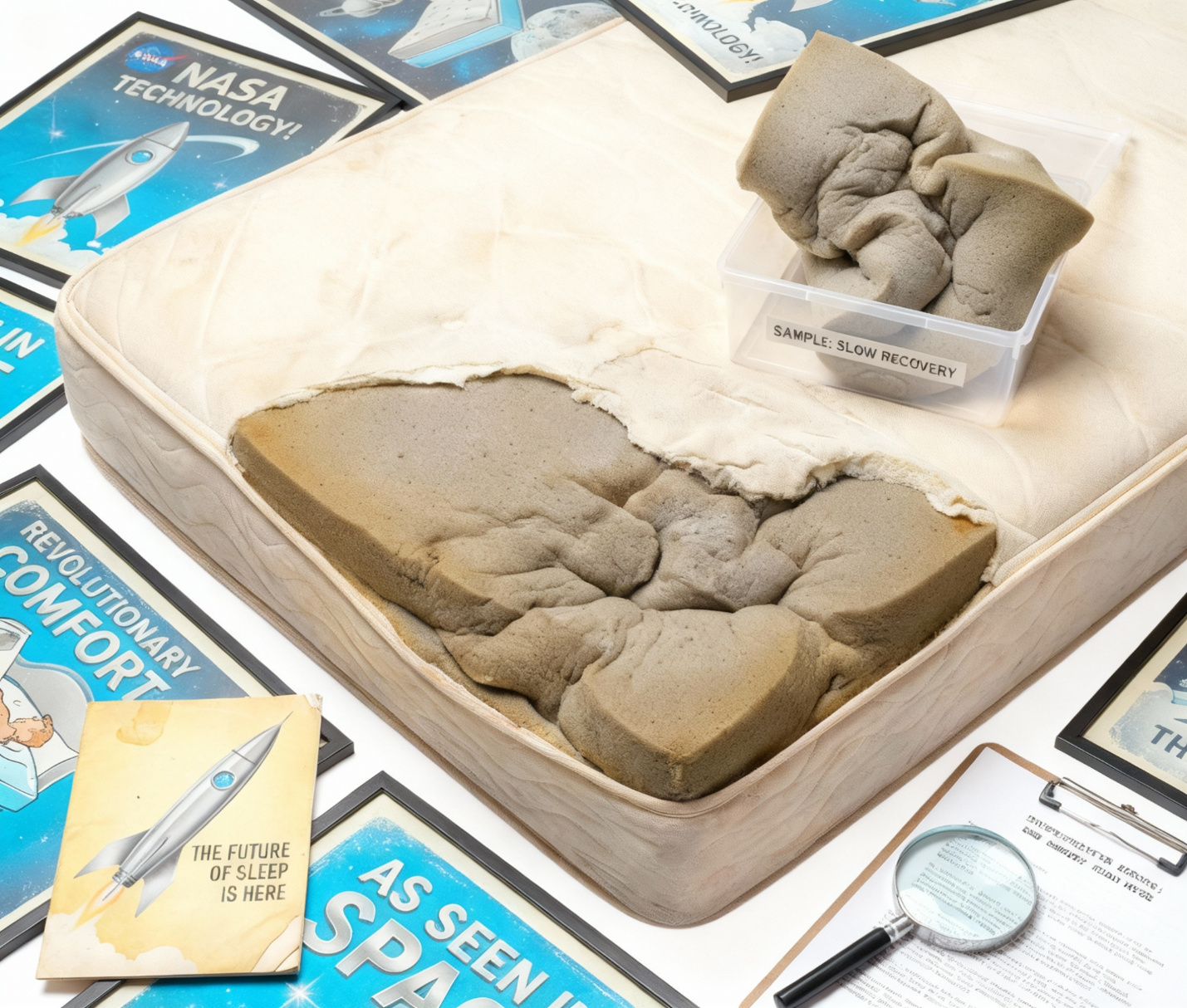
Developed by NASA in the 1970s for aircraft seat cushioning and crash protection, memory foam was commercialised for consumer use by Tempur-Pedic in the early 1990s.
Its primary raw material is polyurethane, a petrochemical-derived plastic polymer blended with polyether polyols, blowing agents, surfactants, catalysts, and flame retardants.
The NASA association was the cornerstone of early marketing, with "space-age technology in your bedroom" being a more compelling story than "dense petrochemical foam", even if the latter is more accurate.
What memory foam does well
Memory foam distributes pressure across a larger surface area by contouring to hips, shoulders, and lumbar, which can reduce localised pain points during sleep.
Its dense structure absorbs partner movement effectively, making it well-suited for couples sensitive to motion disturbance. The same density also resists dust mites and common allergens.
Quality memory foam rated at 3-5 lb/ft3 maintains structural integrity for roughly 7-10 years, though lower-density variants below 3 lb/ft3 can develop permanent body impressions within 2-3 years.
The drawbacks
The most widely reported complaint is heat retention. Memory foam's viscoelastic mechanism responds to body warmth, which means it traps and holds heat, raising sleep surface temperatures significantly.
This is particularly problematic for hot sleepers, menopausal individuals, and those in warm climates. Gel-infused and open-cell variants have been developed to address this, with mixed results.
A related issue is the sinking sensation. The slow response rate that makes memory foam effective for pressure relief also makes repositioning difficult for combination sleepers or those with mobility issues.
Heavy sleepers may bottom out on lower-density layers, and strict stomach sleepers risk spinal misalignment from the contouring effect. Edge support is another consistent weakness, with most all-foam mattresses compressing significantly at the perimeter.
Geopolitical risk
Memory foam is a petrochemical product, and every mattress sold globally is tied to crude oil markets and international trade policy.
The key chemical precursors, MDI and TDI, are derived from crude oil and natural gas, with prices directly coupled to global energy markets.
China has emerged as a dominant force in polyurethane production, hosting major facilities including BASF's $10 billion Zhanjiang complex, and its 14th Five Year Plan explicitly targets supply chain self-sufficiency in chemical manufacturing.
US-China tariff escalations have already contributed to more than a 10% decline in China's share of US trade since 2023, with direct downstream effects on foam product costs.
The Middle East supplies approximately 30% of global seaborne LPG exports, a critical feedstock, and disruption to the Strait of Hormuz could reduce global naphtha supply by up to 24%, triggering cascading price increases across the entire foam supply chain.
Ethical sourcing
The US EPA classifies polyurethane foam manufacturing plants as major sources of hazardous air pollutants. Workers are exposed to isocyanates, TDI and MDI, hydrogen cyanide, and other reactive chemicals.
The CDC has documented cases of isocyanate-induced occupational asthma and respiratory sensitisation. While safety standards have improved in US and EU facilities, plants in lower-regulation jurisdictions present ongoing worker health concerns.
A North Carolina polyurethane plant was forced to close after tests revealed hazardous airborne pollutant exposure in surrounding lower-income communities.
Memory foam is also routinely treated with chemical flame retardants including TDCPP, TCEP, and PBDEs, many linked to hormonal disruption and classified as potential carcinogens, and manufacturers are not required to disclose the specific chemicals used.
Among certifications, OEKO-TEX Standard 100 and GREENGUARD Gold offer the most rigorous independent testing. CertiPUR-US, though widely cited, is an industry self-regulatory body with limited independence. GOTS explicitly prohibits polyurethane foam from certification.
End of life and emissions
The United States discards approximately 18.2 million mattresses per year, of which only around 19% are recycled, meaning roughly 14.7 million go to landfill annually. Each occupies approximately 40 cubic feet of landfill space and can take up to 120 years to decompose.
Memory foam is not biodegradable. Decomposing polyurethane releases toxic byproducts, including hydrogen cyanide, isocyanates, and flame retardants, into surrounding soil and groundwater over decades. When incinerated, foam can release hydrogen cyanide and other toxic gases.
Recycling is difficult because all-foam mattresses lack the high-value recyclable steel of spring alternatives, making the economics unattractive relative to simply producing virgin polyurethane.
Manual disassembly is time-intensive, and contamination from mould, bed bugs, or stains frequently disqualifies mattresses from recycling programmes entirely. Only four US states, California, Connecticut, Rhode Island, and Oregon, have legislated mattress recycling infrastructure.
Pollutant emissions
Memory foam emits pollutants at two stages: industrial manufacturing and consumer off-gassing. EPA-classified manufacturing emissions include TDI, a potent respiratory sensitiser and potential carcinogen, methylene chloride, linked to liver and lung damage, hydrogen cyanide, carbon monoxide, and particulate matter.
At the consumer level, a peer-reviewed Environmental Research study from 2022 monitored VOC emissions from new memory foam mattresses over 32 days, finding that concentrations peaked on day one and decayed progressively.
The four primary compounds, 2-propanol, acetone, chloromethane, and toluene, accounted for 81-95% of total emissions, with modelled one-year average concentrations falling within available indoor air quality guidelines.
Short-term emission half-lives were 4-12 hours; long-term half-lives were around 24 days. High-risk groups, including infants, children, pregnant women, and those with asthma or chemical sensitivities, face the greatest exposure risk.
Practical mitigation is straightforward: off-gas new mattresses in a well-ventilated room for 48-72 hours, use fans to accelerate dispersal, and prioritise OEKO-TEX or GREENGUARD Gold certification, particularly for children's bedrooms.
Natural latex mattresses produce significantly lower VOC profiles than polyurethane foam and represent the most practical alternative for consumers concerned about chemical exposure.