
Synthetic Cloth - What You're Not Being Told
A lifecycle view of synthetic cloth across health, environment, sourcing, labour, and waste.
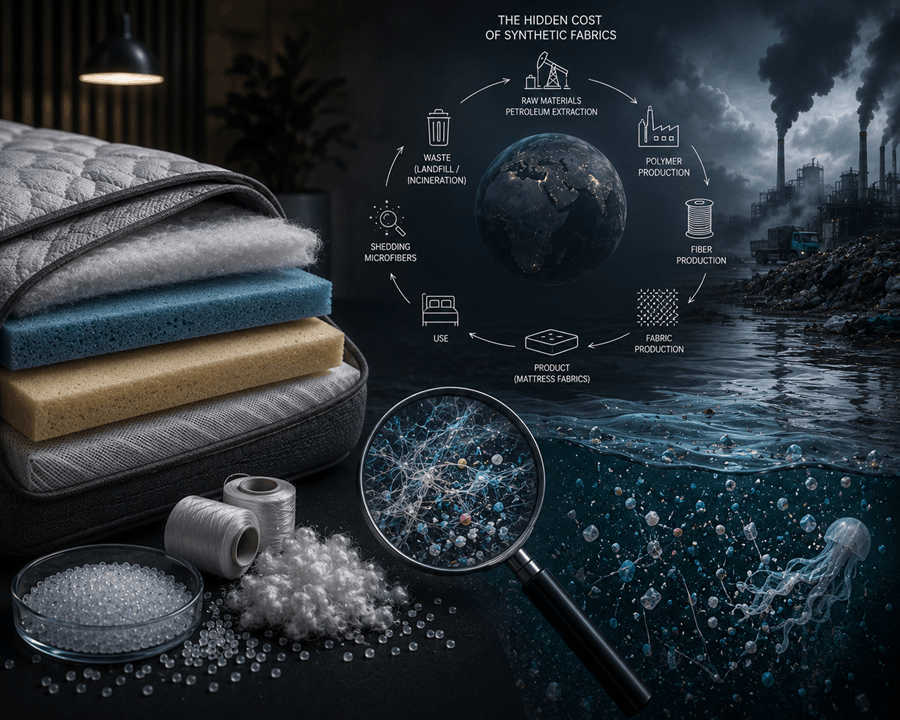
Synthetic Cloth - What You're Not Being Told
Synthetic textiles such as polyester, nylon, acrylic, and spandex now account for over 60% of global fabric production. Made from petroleum-derived polymers, they are cheap to produce and durable in the short term, but their full lifecycle reveals significant costs.
Key takeaways
- Synthetic fibres can trap heat and moisture, encouraging bacterial growth and skin irritation.
- Microplastics, chemical coatings, fossil-fuel dependence, and non-biodegradable waste create long-term health and environmental risks.
- Supply chain transparency and third-party certification are essential to separate genuine sustainability from greenwashing.
Health and skin
Synthetic fibres trap heat and moisture, encouraging bacterial growth and skin irritation.
Many are finished with chemical coatings, including formaldehyde and PFAS, often called forever chemicals, linked to hormone disruption.
Microplastics shed during wear and washing can be absorbed through the skin and inhaled, and have now been detected in human blood, lungs, and placental tissue.
Environmental damage
Synthetic fabrics are non-biodegradable and persist in ecosystems for up to 200 years.
Every wash cycle releases thousands of microplastic fibres into waterways, where marine life ingests them. These particles then enter the food chain and ultimately our diets.
Producing 1 kg of polyester generates roughly 9.5 kg of CO2 equivalent, compared to 3.75 kg for conventional cotton.
Textile dyeing is the second largest polluter of clean water globally, and rivers near synthetic factories, such as the Citarum in Indonesia, are among the world's most contaminated.
Geopolitical risk
Synthetic fibres are derived from crude oil and natural gas, tying the fashion industry directly to petrostate economies and oil price volatility.
The bulk of production is concentrated in China, India, and Taiwan, making global brands vulnerable to trade tariffs, sanctions, and diplomatic tensions.
The COVID-19 pandemic exposed how quickly these concentrated supply chains can collapse.
Chemicals used in production, such as antimony trioxide, are sourced from politically volatile regions, adding further instability.
Ethics and labour
Behind the low price tag lies a complex web of labour issues.
Synthetic textile factories in Bangladesh, Cambodia, and Myanmar have repeatedly been linked to poor working conditions, excessive hours, and poverty wages, affecting predominantly women workers exposed to hazardous chemical dyes.
The 2013 Rana Plaza collapse brought global attention to the human cost of fast-fashion supply chains, many dominated by synthetics.
Child labour has been identified in upstream supply chains by the ILO, particularly in South Asia's cotton-synthetic blend sector.
Many brands market recycled polyester as a solution, but without third-party certification these claims are difficult to verify.
Waste and end of life
Globally, 92 million tonnes of textile waste is generated each year, the equivalent of a rubbish truck of clothing discarded every second.
Most is synthetic and cannot biodegrade. Synthetics in landfill leach chemical dyes and plasticisers into soil and groundwater over decades, while incineration releases toxic dioxins and furans.
Only around 1% of clothing is recycled into new fibres.
An estimated 70% of donated fast-fashion garments cannot be resold, and are shipped to developing nations, particularly Ghana's Kantamanto Market, creating secondary waste crises in communities ill-equipped to handle the volume.
The alternative
The evidence is clear: synthetic cloth carries hidden costs to the planet, to communities, and to human health.
Choosing natural, certified, or responsibly recycled fibres is one of the most impactful decisions a consumer, retailer, or brand can make.
Supply chain transparency and third-party certification, such as the Global Recycled Standard, are the only reliable means of distinguishing genuine sustainability from greenwashing.